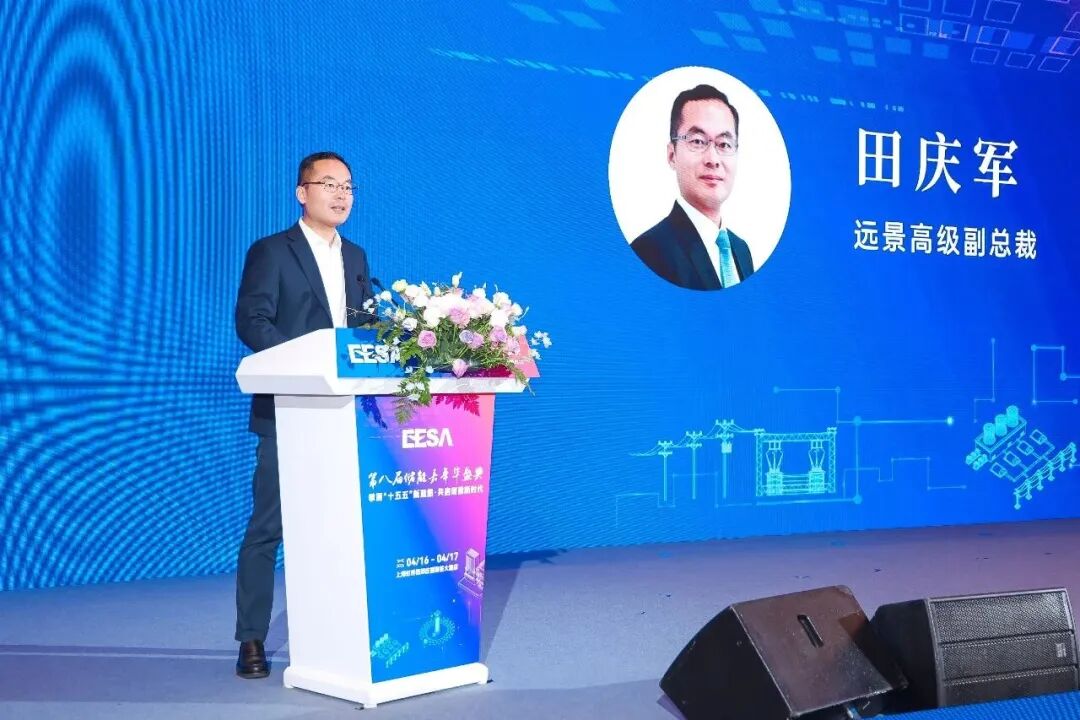
From China Energy Storage Network: Recently, Tian Qingjun, Senior Vice President of Envision, delivered a systematic outlook on the future direction, value logic, and mission of the energy storage industry, based on the 15th Five-Year Plan Outline and the latest national policies for the new energy system. He emphasized that the energy storage sector is at a critical turning point: shifting from serving the power grid to empowering application scenarios.
1. The Future of Energy Storage Depends on New Scenarios, Not Crowded Old Tracks
Tian pointed out that in recent years, energy storage growth has been mainly driven by renewable energy allocation policies, with rapid deployment on the grid side, generation side, industrial & commercial sectors, and user side. However, he warned that the market for grid frequency regulation and peak-shaving ancillary services has a ceiling and will soon become saturated within the next five years.
“As more and more storage stations crowd into limited market space, no one will truly thrive,” he noted.
Citing the 15th Five-Year Plan Outline, he highlighted that China will implement a 10-year doubling action for non-fossil energy, aiming to raise the share of non-fossil energy consumption to 25% by 2030, accelerate the building of a new power system, and promote direct green power supply based on local conditions. This opens huge new incremental space for energy storage.
Tian believes that AI data centers (AIDC) enabled by direct green power connection, as well as off-grid and semi-off-grid new power systems for green hydrogen, ammonia, and alcohol, are becoming the largest incremental markets for energy storage.
- For AI computing centers, power supply reliability requires 99.99%+ uptime, making energy storage mandatory under direct green power models.
- In zero-carbon hydrogen, ammonia, and alcohol parks, energy storage itself becomes the new power grid under 100% off-grid operation.
With national policy supporting the development of green hydrogen, ammonia, and alcohol, energy storage and hydrogen integration faces major opportunities.
He predicted that after five years, energy storage applications will shift significantly from large grid services to load-side applications. Companies that pioneer new scenarios will seize the next development cycle.
2. Energy Storage Cannot Create Value Independently; Scenario Synergy and Ecosystem Capabilities Are Key
“Energy storage is never a standalone profit-making business. It is a value amplifier and connector for application scenarios,” Tian stressed.
The full value of energy storage — in renewable integration, power market trading, weak-grid or off-grid grid-forming — can only be realized by serving scenarios and collaborating with partners. Without specific scenarios, energy storage is merely a charge–discharge device.
The 15th Five-Year Plan Outline calls for improving medium-to-long-term, spot, ancillary service, and capacity markets, supporting new market participants, and refining price mechanisms for the new energy system. Tian stated this will fully unlock the value of energy storage while raising the bar for operational capabilities.
He emphasized that in future energy storage station investments, partner selection is critical. Ideal partners must possess four core capabilities:
- Core R&D capabilities for energy storage technology (not simple assembly)
- Power system solution capabilities
- Operational service capabilities
- Financial solution capabilities“Because energy storage is ultimately a financial asset.”
The era of going it alone is over, he said. Ecosystem synergy is the core competitiveness.
3. Uphold Correct Values, Long-Termism, and Social Responsibility
Tian stated frankly that energy storage is not a high-margin industry. In recent years, some companies entered seeking quick profits and exited quickly once returns fell short. As heavy-asset, long-cycle infrastructure, energy storage supports global energy transition and carbon neutrality, with steady, long-term returns.
The 15th Five-Year Plan identifies energy as the main battlefield for carbon peaking and neutrality. Tian called on industry peers to embrace social responsibility and strategic commitment to global energy transition and security.
Conclusion
Tian concluded with one sentence:In the second half of energy storage, we must not only better serve the main grid but also continuously explore new scenarios and create new value within them.
He called on the entire industry to take scenarios as the battlefield, collaboration as the weapon, and long-termism as the belief, to jointly implement the 15th Five-Year Plan’s new energy system goals and drive the energy storage industry toward higher-quality, more sustainable, and globalized development.